D&D 5e Druid Guide
Druids draw the players who like options — the ones who want to be a bear in one round and a battlefield-controlling caster the next. There’s a quiet creativity to druid players; they tend to think in terms of the whole ecosystem of a fight, not just the next attack. Wild Shape is the headline, and a Moon druid tanking as a dire animal is genuinely one of the toughest things at low levels, but the deeper joy is the flexibility — the sense that nature has a tool for whatever the situation needs.
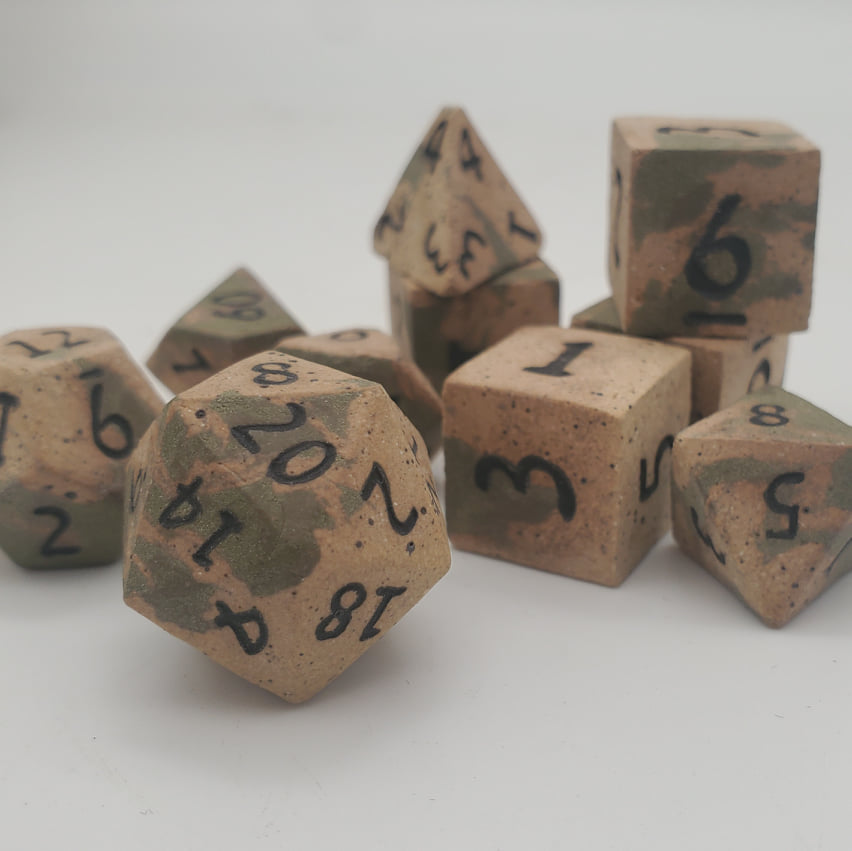
Unsurprisingly, druid players reach for the earthy sets. The Moss Druid set is almost too perfect for the class — green, organic, alive-looking — and the Ancient Oasis set fits the druid who leans toward water and growth over forest. Dice that look like they grew somewhere rather than being made.
Choosing Your Druid Circle
Your Druid Circle fundamentally shapes how you approach combat and problem-solving. Each circle offers a distinct playstyle that emphasizes different aspects of the druid’s versatility.
Combat-Focused Circles
Circle of the Moon transforms you into a melee powerhouse through enhanced Wild Shape. You gain access to combat-viable beast forms with higher challenge ratings, plus the ability to Wild Shape as a bonus action. Early levels see you tanking as a brown bear, while later you become a mammoth or elemental. The trade-off is reduced spellcasting effectiveness, as you’ll spend most combat rounds in beast form.
Circle of Spores offers a unique necromantic approach, using Symbiotic Entity to boost your humanoid form with temporary hit points and necrotic damage. You maintain full spellcasting while gaining melee viability, making it ideal for players who want combat presence without abandoning their spell list.
Spellcaster Circles
Circle of the Land maximizes your spell arsenal with bonus spells tied to your chosen terrain and spell recovery on short rests. You become the quintessential battlefield controller with expanded options like Misty Step or Spider Climb. Each terrain type offers different tactical advantages—Coast druids get Mirror Image and Misty Step, while Forest druids gain Barkskin and Spider Climb.
Circle of Stars provides versatile support through Starry Form, offering three configurations: Archer for consistent damage, Chalice for healing, or Dragon for concentration saves and flight. This circle excels at adapting to party needs while maintaining strong spellcasting.
Support and Utility Circles
Circle of the Shepherd dominates through summoning magic, turning Conjure Animals into an army-building tool. Your Spirit Totems provide powerful auras for allies and summoned creatures, making you invaluable in both combat and exploration.
Circle of Dreams focuses on healing and mobility through Balm of the Summer Court and fey-themed abilities. You can heal allies at range without spending spell slots while gaining access to powerful escape options like Misty Step.
Circle of Wildfire blends destruction and renewal through your Wildfire Spirit companion. You can deal fire damage while providing healing, creating a unique tactical dynamic that rewards positioning and battlefield awareness.
Best Druid Builds
Moon Druid Tank
Prioritize Wisdom for spell save DC, then Constitution for concentration saves when in humanoid form. Dexterity becomes less important since beast forms provide their own physical stats. Key feats include War Caster for concentration saves and the ability to cast spells with somatic components while in Wild Shape at 18th level. Resilient (Constitution) serves as an alternative for concentration protection.
This build excels at soaking damage through Wild Shape’s effective HP doubling, then falling back to powerful concentration spells like Conjure Animals when beast forms drop. Your tactical priority shifts between frontline tanking and backline control based on the encounter.
Land Druid Controller
Maximize Wisdom first, followed by Constitution for concentration, then Dexterity for AC and initiative. War Caster and Resilient (Constitution) become essential for maintaining concentration on battlefield control spells like Entangle, Heat Metal, or Call Lightning.
Focus on terrain manipulation and crowd control rather than direct damage. Your spell recovery feature allows aggressive spell usage, knowing you can regain slots on short rests. Ritual casting provides exceptional utility outside combat.
Shepherd Summoner
Similar stat priorities to Land Druid, but emphasize positioning and battlefield awareness over raw spell variety. Conjure Animals becomes your signature spell, supported by Spirit Totems that enhance your summoned creatures’ effectiveness.
This build requires strong tactical thinking and encounter management skills, as controlling multiple creatures can slow down gameplay if not handled efficiently. The payoff is unmatched action economy dominance.
Stars Druid Versatile
Balanced stat distribution with Wisdom primary, Constitution secondary, and decent Dexterity. This build adapts to party needs through Starry Form choices—Archer configuration when damage is needed, Chalice for healing support, or Dragon for concentration reliability and mobility.
Druid Tactics & Play Tips
Wild Shape serves dual purposes: emergency HP buffer and tactical repositioning tool. Don’t feel locked into beast form for entire encounters—sometimes transforming briefly to absorb a critical hit, then reverting to cast a key spell, provides more value than staying transformed.
Conjure Animals represents exceptional action economy, but requires preparation. Know your local wildlife options and have stat blocks ready. The spell’s power comes from multiple attacks and bodies, not individual creature strength. Eight wolves often outperform one CR 2 beast through sheer volume of attacks and battlefield presence.
Concentration management defines druid success. Prioritize spells that provide ongoing value—Pass Without Trace for exploration, Heat Metal for consistent damage, or Conjure Animals for sustained pressure. War Caster or Resilient (Constitution) becomes nearly mandatory for higher-level play.
Pass Without Trace deserves special mention as potentially the most campaign-changing spell in your arsenal. A +10 stealth bonus for the entire party trivializes many encounters and opens creative problem-solving opportunities that direct damage spells cannot match.
Ritual casting provides enormous utility value. Detect Magic, Speak with Animals, and Water Walk solved through ritual casting preserve your spell slots for combat encounters. This feature alone justifies preparing utility spells over additional damage options.
Best Race Pairings for a Druid
Variant Human provides the coveted early feat access, letting you secure War Caster or Resilient at first level. The flexibility to customize your abilities perfectly matches the druid’s adaptable nature.
Firbolg offers natural synergy with Wisdom bonuses and innate spellcasting that complements druid themes. Hidden Step provides tactical positioning, while Speech of Beast and Leaf enhances your nature-based roleplay opportunities.
Wood Elf combines useful stat bonuses with perception proficiency and bonus cantrips. The weapon proficiencies become largely irrelevant, but the overall package supports both spellcasting and Wild Shape approaches effectively.
Earth Genasi provides Constitution bonuses and Pass Without Trace once per day, directly supporting concentration saves while offering one of the druid’s best spells as a racial feature.
Frequently Asked Questions
What’s the best Druid subclass?
Circle of the Moon dominates early levels through powerful Wild Shape combat forms, while Circle of the Land excels at higher levels with expanded spell options and recovery. Circle of the Shepherd offers the highest power ceiling for experienced players willing to manage summoned creatures. The “best” depends on your preferred playstyle and campaign focus.
Is Moon Druid overpowered?
Moon Druid appears overpowered at levels 2-4 when Wild Shape forms significantly outclass other class features, but this advantage diminishes as other classes gain more powerful abilities. The subclass trades spell versatility for combat prowess, creating a balanced but front-loaded power curve.
Can Druids wear metal armor?
Raw rules state druids cannot wear metal armor, but this restriction varies by table and DM interpretation. Many DMs allow magical metal armor or handwave the restriction entirely. Studded leather and hide armor provide viable alternatives, and shields can be made from non-metal materials.
What’s the best Druid race?
Variant Human offers the most mechanical flexibility through early feat access. Firbolg provides thematic synergy and useful abilities, while Wood Elf supplies solid stat bonuses and utility features. The optimal choice depends on your specific build and campaign needs.
How does Wild Shape actually work?
Wild Shape transforms you into a beast form, replacing your physical stats but retaining your mental abilities, proficiencies, and class features. You gain the beast’s hit points as temporary HP—when you revert, you return to your original hit point total. Equipment merges into the form unless the new form can wear it.
Is Druid good for new players?
Druids offer moderate complexity with Wild Shape mechanics and full spellcasting creating multiple tactical decisions each turn. New players might find Circle of the Land more approachable than Moon Druid, as it focuses primarily on spellcasting rather than juggling multiple forms and abilities.
What beasts can I turn into?
Beast availability depends on your druid level and subclass, with CR limits increasing as you advance. Most DMs allow any beast from the Monster Manual that meets the CR restriction, but some require that you’ve encountered the creature before. Circle of the Moon druids access higher CR forms and eventually elemental shapes.
Featured Ceramic Dice
Handmade ceramic dice sets from Ceramic Dice, picked to suit this class at the table.